
When Washington Stalls, States Power Forward
By: Ashley Hipnar
This article was originally published on October 8, 2025, in Volume 1, Issue 1 of the R.E.A.C.T. by PECC Newsletter.
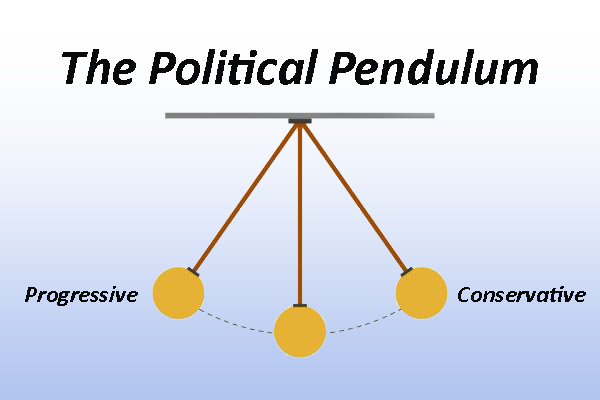
Federal energy and climate law swings like a pendulum, as Obama’s Clean Power Plan gave way to Trump’s lenient Affordable Clean Energy Rule, followed by Biden’s ambitious Inflation Reduction Act (2022). The result? A federal system that feels unreliable and unstable under the constantly shifting political winds. Meanwhile, states are taking the lead, experimenting with renewable energy mandates, emissions caps, and environmental justice programs. These efforts are not just patchwork fixes, they are real laboratories of “climate federalism” that could outlast the ups and downs of Washington politics.
Federal Volatility
Federal climate and energy policy remains volatile by design. Executive orders are routinely used to reverse prior administrations’ directives: President Biden signed twenty-four reversals in his first hundred days, while Trump rescinded eighty on the first day of his second term. These rapid shifts often stretch statutory authority, bypassing Congress to pursue partisan goals. Meanwhile, legislative gridlock has stalled meaningful bipartisan progress since the 1990s. The recent “megabill”, passed in July 2025, marked a significant rollback of climate initiatives. Judicially, decisions such as West Virginia v. EPA (2022) and the overturning of Chevron in Loper Bright Enterprises v. Raimondo (2024) have further constrained federal regulatory power, deepening the instability of long-term energy and climate governance.
State Leadership
While Washington stalls, states have become the backbone of U.S. climate action, advancing durable policies that outlast election cycles. California’s Zero-Emission Vehicle (“ZEV”) mandate, first adopted in 1990 and strengthened fourteen times since, now requires all new passenger cars, trucks, and SUVs to be zero-emission by 2035. This is especially significant as the EPA’s authority to regulate greenhouse gases faces threats from efforts to repeal the Endangerment Finding.
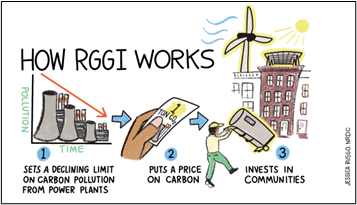
Meanwhile, eleven northeastern states joined forces through the Regional Greenhouse Gas Initiative (“RGGI”), the “first mandatory cap-and-trade program in the United States to limit carbon dioxide from the power sector.” These eleven states set a regional cap on carbon dioxide emissions from regulated power plants, reducing the allotted emissions over time. Since 2005, RGGI has cut power-sector emissions by 50%, nearly twice the national speed, while generating $8.6 billion for community investment.
New York launched its own initiative in 2019 with the Climate Leadership and Community Protection Act (“CLCPA”), setting legally binding targets of “100% zero-emission electricity” by 2040 and at least an 85% emissions reduction from 1990 levels by 2050. The Act not only aims to create a healthier New York but also works to increase access to affordable energy through clean solutions, while empowering disadvantaged communities with quality-paying jobs and diversifying opportunities.
Minnesota has a similar plan. In 2023, the state passed a law requiring 100% carbon-free electricity by 2040, with interim steps of 80% carbon-free by 2030 and a requirement that utility retail electric sales increase renewable energy to 55% by 2035. While electrical utilities in Minnesota have decreased carbon emissions from 54% from 2005 to 2020, this law locks in that progress while giving them room to finish the job effectively.
Constitutionality
Environmental protection and public health have never been recognized as enumerated rights under the Constitution, and federal agencies are steadily losing authority in the environmental sphere. This makes federalism central to advancing clean energy standards and climate momentum. Under the Tenth Amendment, powers not delegated to the federal government are reserved to the states, giving them a vital role in regulating energy and protecting natural resources. As Justice Louis Brandeis famously observed, states act as “laboratories” of democracy, testing innovative solutions to pressing social and economic challenges (New State Ice Co. v. Liebmann, 285 U.S. 262, 311 (1932)).
States have broad authority to enact environmental protections but face recurring challenges from federal preemption. In 2024, the Trump Administration issued Protecting American Energy from State Overreach, an executive order aimed at curbing state and local climate policies. Such attempts raise serious constitutional questions, especially given that cornerstone environmental statutes–such as the Clean Air Act–explicitly preserve the ability of states to adopt more stringent standards than federal law.
These tensions are now playing out in court, as fossil fuel companies once eager to remove climate suits to federal forums, are increasingly being forced to defend themselves in state courts after repeated preemption arguments have failed. Right now, the real fight for clean energy is happening in the states, and that is where the momentum lies.
This article was written by PECC's Energy and Climate Law Scholar Ashley Hipnar, a law student at Elisabeth Haub School of Law at Pace University and Yale School of the Environment.
Editors: Mercè Martí I Exposito, Frances Gothard, Carington Lowe