Practitioners' Corner
Samuel Carvalho | Haub Law SJD ‘27 LL.M ‘25
First Conference on Transitioning Away from Fossil Fuels: Investor-State Dispute Settlement as a Barrier to a Just Transition
At COP30 in Belém, States failed to reach consensus on a roadmap for phasing out fossil fuels. While the UNFCCC remains an essential forum for global climate action, its consensus-based structure continues to pose significant challenges to adopting strong commitments and meaningful action regarding the fossil fuel industry.
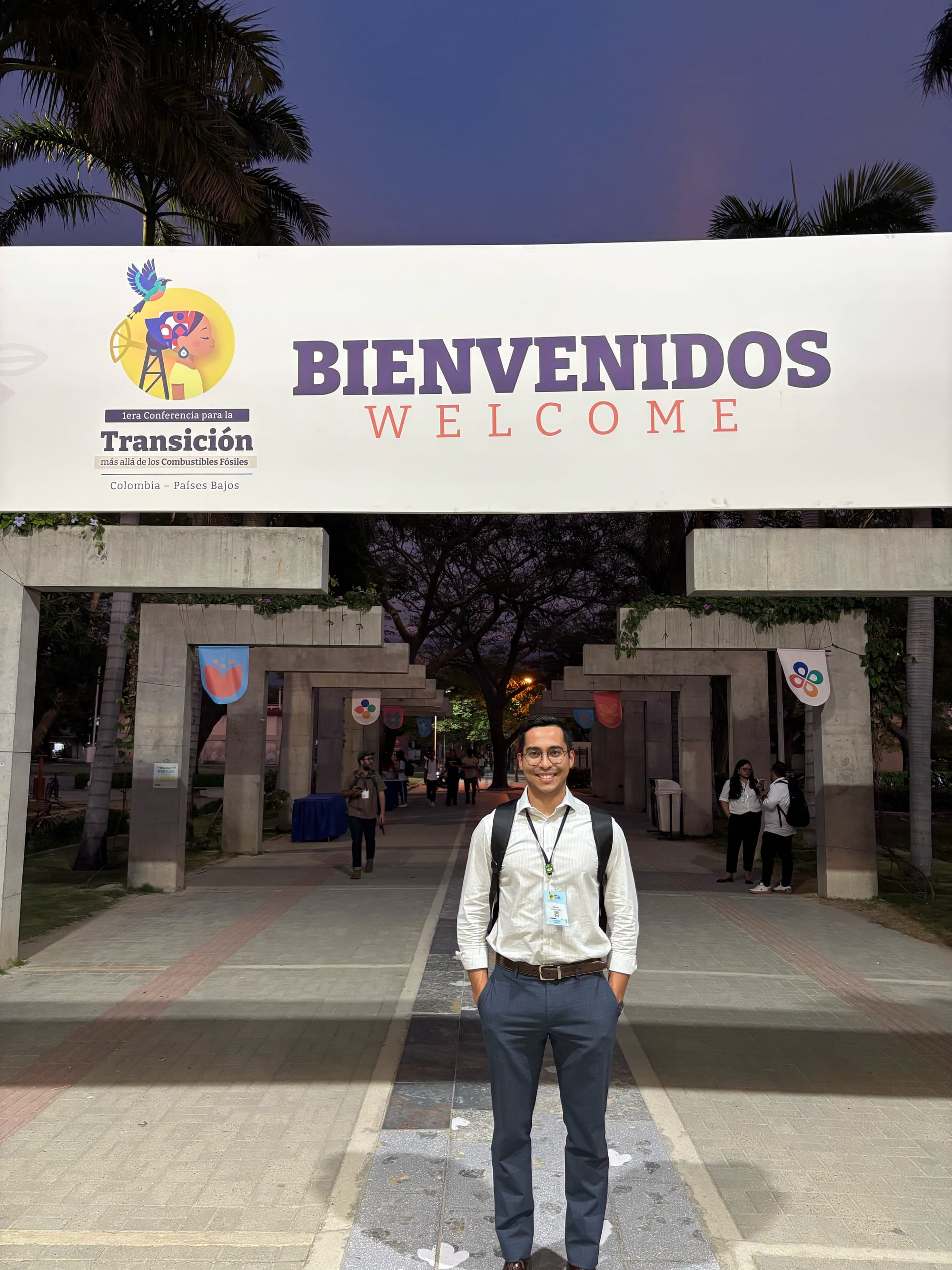
This context gave rise to the First Conference on Transitioning Away from Fossil Fuels ("TAFF") in Santa Marta, convened by Colombia and the Netherlands. Designed as a solutions-oriented forum operating outside the traditional international climate architecture, the conference brought together nearly 60 countries supporting the commitments of the Paris Agreement, alongside representatives from academia, social movements, NGOs, trade unions, Indigenous Peoples, and others. It created a unique and important space for dialogue on how to transition away from fossil fuels.
Discussions focused on reducing economic dependence on fossil fuels, transforming energy supply and demand, and strengthening international cooperation. Key outcomes included the launch of the Science Panel for the Global Energy Transition ("SPGET"), aimed at supporting countries in overcoming fossil fuel dependence, and the establishment of three workstreams dedicated to identifying concrete opportunities and channels for cooperation ahead of the second conference in Tuvalu, which will be co-hosted by Ireland. Moreover, the conference addressed Investor-State Dispute Settlement ("ISDS") and the challenges it imposes on a just energy transition.
Investor-State Dispute Settlement
Currently, the ISDS mechanism allows fossil fuel corporations to sue governments that implement climate transition policies for millions or billions of dollars, resulting in a chilling effect on climate policy. ISDS provisions are included in numerous bilateral investment treaties ("BITs"), multilateral investment treaties ("MITs"), and investment chapters of free trade agreements ("FTAs"). These provisions allow foreign investors to bring claims directly before arbitral tribunals without first seeking recourse in domestic courts. In practice, this enables fossil fuel companies to challenge State climate measures when such regulations affect their investments. For example, RWE, a multinational energy company, initiated ISDS proceedings against the Dutch government seeking approximately €1.4 billion in compensation after the Netherlands enacted legislation to phase out coal-fired power generation by 2030.
Since 1998, fossil fuel and mining companies have received more than $87 billion in ISDS awards from States. Corporations from the Global North have been the primary beneficiaries of this system, often at the expense of governments in the Global South. This dynamic creates significant climate justice and equity concerns, as developing countries are frequently required to engage in costly arbitration proceedings and, in many cases, pay exorbitant awards to Global North fossil fuel corporations instead of directing those resources toward climate mitigation and adaptation efforts.
Additionally, many investment agreements contain “sunset clauses,” which provide that investment protections and access to ISDS remain in force for years even after a State withdraws from the treaty. For example, the Energy Charter Treaty ("ECT"), an energy investment treaty and one of the main drivers of ISDS-climate-related litigation, contains a 20-year sunset clause, protecting fossil fuel investors for two decades following a State’s withdrawal from the treaty. Within this context, eliminating ISDS and neutralizing sunset clauses are imperative to enabling States to reclaim their sovereign policy space necessary to effectively regulate private actors and advance a just energy transition. This can only be achieved through coordinated State action to renegotiating existing investment agreements, collectively withdraw from treaties such as the ECT, and commit to refraining from entering into future agreements containing ISDS provisions.
Defenders of the ISDS system often argue that these mechanisms are necessary to attract and protect foreign investment in developing countries. However, a 2014 analysis by the United Nations Conference on Trade and Development ("UNCTAD"), examining 146 economies over a 27-year period, found no evidence that BITs and ISDS clauses foster increased bilateral Foreign Direct Investment (FDI). Brazil, for example, is not party to any international investment agreements containing ISDS provisions and, nevertheless, remains among the world’s top ten destinations for FDI.
Colombian President Gustavo Petro recently announced his intention for Colombia to withdraw from the ISDS system following a letter received from 220 economists and legal scholars calling for action on ISDS, of which the Pace Energy and Climate Center ("PECC") was a signatory. This highlights the important role that academic and civil society organizations play in shaping future climate policy decisions and contributing to a just transition away from fossil fuels.
ISDS at the Conference
PECC actively participated in the ISDS workstream of the Academic Dialogue, contributing to discussions on legal pathways for overcoming ISDS, as well as assisting in drafting recommendations for States. As part of the academic report, the workstream called States to explicitly recognize ISDS as a key legal barrier to a just transition and the urgent need to address it collectively, including through terminating or withdrawing from existing treaties. Furthermore, it recommended that States to launch a Working Group with participation of affected communities, public interest organizations, vulnerable groups, academics, and Indigenous Peoples to collectively address ISDS. The Working Group would also report back on progress in implementing these recommendations at subsequent TAFF conferences.
Similarly, civil society and trade unions reports were equally clear that ISDS constitutes an obstacle to the just transition, reiterating the need to end the system. However, by the end of the conference, the “Co-hosts’ takeaways” publication had watered down the existing consensus regarding the need to eliminate ISDS. The final document stated that ISDS mechanisms “by some were perceived as creating barriers, while the extent to which these barriers are perceived varies”. This language weakens the conclusions reached by the academic, civil society, and trade unions dialogues, and reinforces the need to continue advancing work on this critical issue.
Conclusion
The First Conference on Transitioning Away from Fossil Fuels marked an important starting point for collective action focused on concrete solutions for a just transition and delivered a powerful and clear message on the need to phase out fossil fuels. The conference also underscored the urgent need to address ISDS and helped to move the agenda forward.
In preparation for the second conference in Tuvalu, PECC will continue to contribute to discussions and providing insight into legal pathways for addressing the ISDS obstacle. This includes research on how the International Court of Justice Advisory Opinion on the Obligations of States in Respect of Climate Change affects existing ISDS cases, led by our Executive Director, Michael Hamersky, and me, PECC’s Graduate Fellow. PECC’s efforts further include research, led by PECC Scholar Samirah Aziz and PECC’s Fellow Akinola Afolarin, on how the evolution of odious debts legal analysis can support Global South efforts to avoid fossil fuel debt in nations disproportionately bearing the brunt of the climate crisis. This research is expected to be published by the Fossil Fuel Non-Proliferation Treaty Initiative in the coming months.

Pianpian Wang | Haub Law SJD ‘24 LL.M ‘13
Active in the private sector, Pianpian has advised clients across industries ranging from agile start-ups to global Fortune 500 companies, delivering practical solutions that align with evolving regulations and stakeholder expectations. She believes that business, when guided by responsibility and purpose, can serve as a powerful catalyst for advancing environmental and social governance.
As an admitted lawyer in China, Pianpian focuses on environmental, corporate, and labor law. She is a member of the IUCN World Commission on Environmental Law and a frequent speaker on climate and sustainability topics. Her academic contributions include serving as a visiting scholar at Vermont Law School in 2012 and a guest lecturer on carbon trading between 2022 and 2024.
Publications:
- Voluntary Environmental Programs in the United States and China, 2026 by Routledge (forthcoming).
- Legal Considerations for Climate Transition Plans, American Bar Association Blog, January 2025.
- Chapter Researcher and Contributor to A Tale of Two Cities; A Comparison of Air Pollution Governance in the Los Angeles Area of the USA and the Beijing-Tianjin-Hebei Area of China, 1st Edition, Wang Xi, Richard Ottinger, 2024 by Wolters Kluwer.
- From Polluters to Protectors: The Potential of Unilateral Environmental Commitments Made by Companies in the U.S. and China, Vol.24 Issue 4, Vermont Journal of Environmental Law, 348 (2023).
- Carbon Trading - International Coordination to Address Climate Change, Comparative Environmental Law and Regulation (Elizabeth Burleson, Nicholas Robinson & Lin Heng Lye eds (Thompson Reuters: 2021).
- Co-Author to Chapter 17 Accelerating the Energy Transformation of Fulfilling the Sustainable Development Goals, 1st Edition, Edited by Narinder Kakar, Vesselin Popovski, Nicholas A. Robinson, August 31, 2021, by Routledge.

Christopher Bloch | Haub Law ‘10
Since the start of his journey at Elisabeth Haub School of Law at Pace University ("Haub Law") in 2007, Christopher Bloch knew he wanted to incorporate a strong international component into his work. Since graduating in 2010 with his J.D. and Advanced Certificate in International Law, Chris began his career as a research fellow at Pace’s Institute of International Commercial Law (“IICL”) and as a graduate advisor at the Pace Investor Rights Clinic (“PIRC”). He later clerked for one of the world’s leading independent arbitrators, administered over 250 cases as a member of the Secretariat at the Singapore International Arbitration Centre (“SIAC”), and represented clients as counsel in over 40 international commercial and investment treaty disputes across various sectors, including traditional and renewable energy, mining, and natural resources.
Now based in Singapore, Chris is a Senior Associate in the International Dispute Resolution Practice of Squire Patton Boggs, where he represents clients in international commercial and investment treaty arbitrations across a broad range of industry sectors. His focus, however, has been on cases involving the energy transition—long-term LNG SPAs, gas price review, wind and solar projects, and critical mineral exploration. While not involved in environmental law in the traditional sense, Chris’s practice often addresses energy and environmental regulations, power utilities, and long-term energy security.
Although Chris’s career has taken him across several foreign jurisdictions and followed an unconventional path, he traces the foundation for each step back to his time at Haub Law. Like many students entering law school, Chris appreciated the broad range of possible career paths, but he quickly discovered a particular interest in international law and chose to dedicate his three years at Haub Law to pursuing that focus. Having lived in Bangkok, Thailand, for several years before law school, Chris sought more than just the courses listed in the catalogue, he wanted to take advantage of every international opportunity Haub Law offered. To gain a well-rounded understanding, he took International Law with Professor Gayl Westerman, which introduced him to the “public” side of international law. He also completed courses such as International Sales Law and International Commercial Arbitration and served as a Student Attorney at PIRC, working under Dean Gross’s tutelage to gain a “private” perspective.
The reality of a career in international law is that cases before bodies such as the International Court of Justice ("ICJ") or the International Tribunal for the Law of the Sea ("ITLOS") are few and far between. In contrast, international commercial arbitration sees tens of thousands of cases annually, spanning major industries like energy, natural resources, infrastructure, telecommunications, and environmental law. Recognizing this, Chris understood that getting a well-rounded view of international law and developing advocacy skills in a clinical setting was the best way to lay the foundation for his career.
During both of his law school summers, Chris ventured abroad to work in two vastly different international arbitration practices—first supporting construction arbitrations at Clayton Utz in Sydney, Australia, and later working on corporate and energy cases at Freshfields in Cologne, Germany. After law school, Chris accepted a research fellowship at Pace’s IICL, where he assisted with research projects involving the United Nations Convention on the International Sale of Goods ("CISG") and other alternative dispute resolution processes. He also volunteered as a graduate advisor, mentoring students taking part in PIRC, a pro bono law clinic representing clients in securities disputes with broker-dealers under the auspices of the Financial Industry Regulatory Authority ("FINRA").
In 2011, Chris made the decision to move to Singapore to accept a position as a clerk for Michael Hwang SC, one of the city-state’s leading independent arbitrators, assisting tribunals as an “arbitral secretary” in complex international arbitration proceedings. He spent two years in that clerkship, helping to manage both international commercial and investment arbitrations, and drafting portions of the awards. Chris then went on to serve as a Senior Member of the SIAC Secretariat, where he contributed to major revision efforts of SIAC’s arbitration rules in 2016 and helped draft the first-ever set of institutional investment arbitration rules, released in 2017, in addition to the case administration roles the SIAC serves. In these roles, Chris continued to build experience in energy-related disputes, further shaping and defining his practice in that area.
Having now worked in private practice for a decade, Chris’s practice has largely focused on representing clients, including sovereign states, in a wide range of disputes across the energy industry, while also handling matters in sectors such as mining, telecommunications, and the defense industry. The cases he has managed are diverse, often involving sums ranging from hundreds of millions to tens of billions of U.S. dollars. His work has spanned issues from force majeure claims arising out of hurricane damage to an LNG loading facility in the United States to assessing the commercial impact of the Rohingya refugee crisis on a solar project in Bangladesh. On any given day, he might spend the morning addressing a dispute over subsea foundation work for an offshore wind farm and the afternoon managing environmental breach and pollution claims involving an energy consortium developing an offshore oil and gas field. He has even worked on a series of parallel arbitrations over the impact of the Russia-Ukraine Conflict on a national telecommunications satellite program, which involved expert testimony from rocket scientists.
Given the confidentiality of international arbitrations, the details of most of his cases rarely make the news, though the projects themselves regularly grace the front pages of newspapers around the world. The field of international arbitration is often fast-paced and demanding, requiring substantial international travel and conducting hearings in various cities around the world like London, Paris, Vienna, Washington D.C., or Geneva. Yet, despite its challenges, the work’s impact is profound; there is rarely a dull moment for a modern international arbitration practitioner.

Elizabeth J. Mackay, CFA, Esq. | Director and Counsel, The Vander Weele Group, LLC
States React to Environmental Policy's About-Face
One did not have to follow politics closely to know that energy and climate policy would undergo a dramatic overhaul with the change in administration. While the former administration implemented large-scale programs to address the negative effects of climate change and promote clean, renewable energy, the new administration does not recognize climate change and instead advocates for the expansion of fossil fuels, focusing on energy security and meeting unprecedented load growth from artificial intelligence ("AI") development. What was not expected, however, was the rapidity of change and the wholesale termination of programs established pursuant to the Bipartisan Infrastructure Law ("BIL") and the Infrastructure Investment and Jobs Act ("IIJA").
In the universe of Federal awards, it has long been accepted that obligated funds were untouchable. Now that the administration has terminated funding—and even clawed back funding—that was obligated in the Federal Emergency Management Agency’s ("FEMA") Building Resilient Infrastructure and Communities ("BRIC") program, the Environmental Protection Agency’s ("EPA") Solar for All program, and certain Department of Energy ("DOE") Grid Resilience and Innovation Partnership ("GRIP") projects, the legality of that assumption concerning obligated funding will be decided in the courts.
In last month’s issue of R.E.A.C.T. by PECC, Ashley Hipnar’s article, “When Washington Stalls, States Power Forward,” described the ways in which states were carrying the mantle for clean, renewable energy and climate change resiliency without leadership from the federal government. The states are also using all legal means at their disposal to push back against the dismantling of established programs that serve these ends. As a starting point, during the public comment period, states were among the broad spectrum of stakeholders—including PECC—to protest the EPA’s proposal to rescind the Endangerment Finding and the emissions standards that resulted.
On April 4, 2025, FEMA dissolved the BRIC program, reclaiming $750 million of unallocated funds appropriated under the BIL and halting payment for fully obligated projects that had not begun construction. The termination occurred due to an alleged lack of impactful results in the program, among other factors, as FEMA shifts more responsibility for disaster recovery to the states. Twenty states sued FEMA, arguing that FEMA exceeded its authority by ending the program and reallocating $4 billion that Congress had allocated to BRIC. On August 5, 2025, the U.S. District Court in Boston granted the plaintiffs a preliminary injunction, deciding that the balance of hardship and public interest favored the states. However, instead of reinstating the funds for BRIC, the judge froze the funds.
The President’s Executive Order, “Ending Market Distorting Subsidies for Unreliable, Foreign Controlled Energy Sources,” targeted wind and solar programs and emphasized the provision in the One Big Beautiful Bill that eliminated the Greenhouse Gas Reduction Fund. Consequently, on August 5, the EPA cancelled the Solar for All program for which $7 billion was obligated.
The states responded to the Solar for All termination with legal actions on multiple fronts. On October 15, fifteen states, led by the California Public Utilities Commission ("CPUC"), filed suit in the U.S. Court of Federal Claims seeking monetary damages for breach of contract. The next day, citing the separation of powers doctrine, nineteen states sued the EPA in the U.S. District Court for the Western District of Washington to reinstate the grants. Taking a third path, Oregon challenged the agency’s decision through administrative action. The administrative court has until February 2026 to rule on the fate of Oregon’s $86.6 million Solar for All program. Taking yet another tack, the American Federation of Labor and Congress of Industrial Organizations ("AFL-CIO"), as the lead plaintiff, sued the EPA in the U.S. District Court for the District of Rhode Island for rescinding the obligated funding without congressional approval.
On October 1, the Director of the Office of Management and Budget ("OMB") cancelled $7.6 billion in climate awards for sixteen states controlled primarily by Democrats. The OMB has terminated 223 DOE projects, including major infrastructure initiatives such as the $500 million Grid Innovation Program in Oregon for energy transmission from tribal lands to the western side of the Cascade Mountains. Colorado has approximately $550 million in clean energy funding in jeopardy. The states have 30 days to appeal the OMB’s decision.
The rulings in these separation of powers cases will have a huge impact in the environmental space and broader implications for the administration’s agenda, and the issue will most likely wend its way into the U.S. Supreme Court. We will keep you updated regarding these legal and other regulatory developments in subsequent issues of R.E.A.C.T. by PECC.